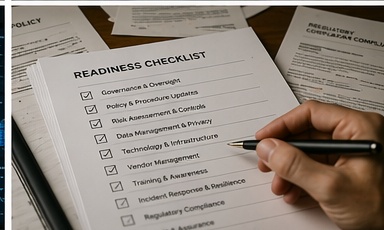
A major Australian bank has confirmed that its flagship artificial intelligence transformation programme has entered its fifth year of foundational planning. The programme, originally scheduled for a three-year implementation, is now described internally as being in its “design maturity” phase. Senior executives said the programme remained on track for delivery, and noted that the delivery date was being refreshed.
The programme was first announced in 2021 alongside a strategic refresh, a brand-aligned slide deck, and a press release describing the bank’s intention to become an “AI-native financial institution by 2024”. The 2024 milestone has since been redefined to refer to the milestone itself.
A statement issued in support of the programme’s most recent quarterly checkpoint described the bank as “well-positioned to capture the long-term opportunity presented by enterprise AI”. The long-term opportunity is now in its medium term.
A Programme In Iterative Foundational Mode
Materials presented to the board describe the programme as progressing through iterative foundational alignment. Foundational alignment is described as “the prerequisite to readiness”. Readiness is described as “the prerequisite to delivery”. Delivery is not yet on the agenda.
Internal documentation reviewed by The Ledger describes seven workstreams: data quality, governance, architecture, talent, vendor selection, platform, and ethics. Each workstream is currently in flight. Three are in flight following a relaunch. One has been in flight twice.
A senior official familiar with the programme said the bank had taken what they described as “a long view” on AI capability. “We’re not interested in moving fast and breaking things,” the official said. “We’re interested in moving deliberately and breaking nothing.” The official confirmed that, to date, nothing had been broken.
“The programme is exactly where it needs to be,” an executive sponsor told a recent town hall, “which is to say, not yet at the part where any of it has to work in production.” The town hall slide deck was described by attendees as well-prepared.
We accept anonymous submissions from inside the industry. Steering committee post-mortems, vendor demo recaps, and lightly fictionalised consulting anecdotes are particularly welcome. Monthly featured contributors receive recognition and a modest prize.
Contributor guidelines ›The Vendor Evaluation, Phase Three
A vendor evaluation process commenced in 2023 has now entered its third iteration. The first iteration produced a shortlist. The second iteration revisited the shortlist following a market change. The third iteration is reviewing the second iteration. A formal vendor decision is expected “within the current planning horizon”, a phrase that has appeared on the executive dashboard for three consecutive financial years.
Industry observers have noted that several of the bank’s competitors have completed AI deployments during the same period. Asked whether this represented a competitive risk, the bank declined to comment beyond noting that those competitors had taken “a different approach”, and that the bank’s own approach reflected “its scale and risk appetite”. The bank’s risk appetite is currently under review.
Spending on the programme to date is estimated at $180 million, of which approximately $145 million has been categorised as discovery and design. The remaining $35 million has been allocated to vendor evaluation and steering committee operations. No production AI capability has yet been delivered to a customer-facing channel. A small number of internal pilots are described as “in learning mode”, which a consultant familiar with the programme clarified means they have not yet learned anything.
The 2026 Reset
A revised programme charter has been circulated. The charter renames the programme. The renamed programme is structured around six pillars, replacing the previous seven workstreams. The seventh workstream has been retired and replaced with a cross-cutting capability theme that runs across the six pillars.
The new charter describes the programme as having “completed the foundation phase” and as “now entering the readiness phase”. The readiness phase is expected to last 18 to 24 months. The bank declined to confirm whether the readiness phase is the same as the previous foundation phase.
A consultant familiar with the programme observed that the renaming had been welcomed internally. “It signals a fresh start,” the consultant said. “The teams are energised. They’ve redone the kickoff offsite. There was a new quote on the screen. Everyone agreed it was a strong quote.”
The bank’s executive committee is scheduled to receive a programme update at its next meeting. The update is expected to confirm that the programme is on track for the next milestone. The next milestone has been redefined to be the next update.