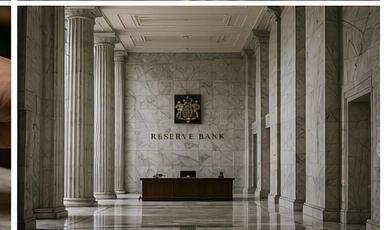
Three of Australia's four marble-floored spreadsheet museums jointly published a 94-page strategic paper titled "Towards A Collaborative Framework For Digital Currency Infrastructure" addressing the emerging role of stablecoins in the Australian financial system. The paper concluded that stablecoins present "significant opportunity and risk" and recommended the establishment of a working group to develop a framework, which would produce a paper, which would inform a consultation, which would produce recommendations, which would require further alignment.
The three banks — expressed confidence that a coordinated industry response was essential. Each maintained a distinct position on what that response should be. A representative from a leading payments provider noted that "all stakeholders agree stablecoins matter", adding that "there is broad consensus that a collaborative approach is necessary." When asked what the collaboration would involve, the representative confirmed that "the paper makes that clear" and directed enquiries to page 67. Page 67 contains a footnote referring to an appendix titled "Future Policy Coordination Mechanisms", which has not yet been completed.
A Paper On Papers
The joint paper's appendix lists seventeen open questions. Fourteen of these appeared identically in a 2023 strategic paper on the same topic published by the national industry payments council. Three are genuinely new. One has been answered. The answer appears in a footnote on page 89, which references a forthcoming consultation paper from the central bank. That consultation paper is expected in Q3 2026.
The CEO of the nation's largest orange-branded bank offered a characteristically expansive comment: "Stablecoins represent an exciting frontier for payments innovation, and we are committed to participating constructively in shaping the regulatory environment." His statement did not address whether the bank was actually building a stablecoin, which it is not. The red-branded major bank's chief noted that "stablecoins require appropriate caution", whilst The oldest of the four majors emphasised a "customer-centric approach", a phrase that has appeared unchanged in the bank's strategic papers since approximately the time of the global financial crisis.
"We see tremendous opportunity if the framework can be developed in a manner that balances innovation with prudential safeguards," said an unnamed executive from a leading payments provider. "The question is less whether stablecoins will be important and more how we collectively ensure they are safe."
The Bank That Declined
We accept anonymous submissions from inside the industry. Steering committee post-mortems, vendor demo recaps, and lightly fictionalised consulting anecdotes are particularly welcome. Monthly featured contributors receive recognition and a modest prize.
Contributor guidelines ›Australia's fourth major bank declined to co-author the paper, citing "governance reasons" that were not elaborated. It will release its own stablecoin strategy paper separately. That paper is also forthcoming. Industry observers note that this creates a scenario where the four largest banks have published — or will publish — four distinct positions on stablecoin coordination, each described as necessary for alignment, none of which appear compatible with the others.
A regulatory affairs consultant observed that "this is normal for a market working through emerging asset classes." The market has been working through stablecoins since 2021. The working group mentioned in the paper is the fifth such working group established on the topic in the last three years. The first working group's recommendations have not yet been released.
Agentic AI And The Paper Review Cycle
Meanwhile, a card-infrastructure-backed AI payments protocol is now executing transactions faster than the banks can complete their papers. A fintech startup announced that its agentic AI system has begun executing payments autonomously, without human review, using stablecoin rails. The payments are processed in milliseconds. The process of approving them for publication takes four to six weeks. Several major banks have expressed interest in the technology while simultaneously noting they need to better understand the regulatory framework before proceeding. The regulatory framework is being determined by a working group that meets quarterly.
An executive at a leading payments provider described the situation as "encouraging", adding that "fast-moving technology and measured regulatory development can coexist." They did not specify how this coexistence would function in practice. When pressed, they referred to the forthcoming consultation paper.
All four banks agreed that stablecoins require a coordinated industry response. None could agree on what that response should be. The paper recommends establishing a workshop to discuss how to coordinate. The workshop is scheduled for Q4 2026.